Showing posts with label gold coast concrete scanning. Show all posts

Tuesday, January 14, 2014

Discovering A Topnotch Concrete Scanning Company


Needing a concrete scanning company is something that the majority of companies and homeowners will never ever require however when you need one it is important to discover the best one in your general local area.
Businesses that supply concrete scanning are normally specialists at scanning but there are some business that aren't as good as others.

Some individuals will employ the initially company that they discover but I suggest that you in fact do some research. The type of research that I recommend is for you to make up a list of around twelve concrete scanning companies in your area. Your objective will be to cut this list down to only the very best 3 or 4 business. The technique that you will use to do this is to make use of Google and other company review sites that allow past consumers to rate businesses. The very best ones permit customers to leave a few paragraphs about the business.


We are undoubtedly searching for a means to stay clear of bad companies and to just deal with business who have an excellent reputation. These reviews are surprisingly great and can assist you get to the core of what a business is everything about. Call each business to see exactly how you like them and then call them out for an estimate as soon as you have your list knocked down.

Following the process that has actually been supplying in this article will enable you to find the very best concrete scanning business in your company to have this sort of work done. Best of luck with your search.

54 Hooker Blvd
Broadbeach,
QLD
4218
Contact us: 0426 508 755

Concrete X-Raying Now


I know there might be concerns about what we are stepping on. so many structures are built up around us without any care as to weather there might be something valuable underneath. When you are looking for the right way to look through something that can not easily be broken or should not be broken you might want to look into concrete X-raying.

If there were diamonds under your office building or parking lot don't you think you should know of it? If you find a lot of them, it might be worth taring the hole place down. I need you to think of all the possibilities when it comes to looking at the unseen.

There are other reasons to figure out what may or may not be under the concrete around you. When you choose to go with concrete X-Raying your mind will be set at ease once you learn that your parking lot or office building is set on a solid structure.

There might be historical items under your office building that you were unaware of. Of course, you might not be willing to break concrete to go get them, but who know?

If you are looking for a quality company to help you with all of your concrete
X-Raying needs all you have to know how to do is use Google.. Please look up the best reviews possible so you know you are getting the right company. Don't waste your money, get the right people for the job.

When you are looking for the right way to look through something that can not easily be broken or should not be broken you might want to look into concrete X-raying.

When you choose to go with concrete X-Raying your mind will be set at ease once you learn that your parking lot or office building is set on a solid structure. If you are looking for a quality company to help you with all of your concrete X-Raying needs all you have to know how to do is use Google.

C.S.I.Concrete Scanning & Investigation
54 Hooker Blvd
Broadbeach,
QLD
4218
Contact us: 0426 508 755

Sunday, December 8, 2013

Location of Rebar in a Reinforced Concrete Structure Is Very Important While Carrying out Modifications


Concrete has a very high compressive strength compared to its tensile strength which is very low. It is possible to increase this tensile strength by introducing rebar in to concrete to make a reinforced concrete structure which can then take both compressive and tensile stresses and make for structures that have strength and durability.


Concrete lends itself very easily to be molded into any shape that is desired, because when it is first manufactured it is in a plastic state, which over a short period of time hardens, while continually developing strength. CSI finds rebar etc in concrete to reinforced concrete needs to be put at very specific locations so that it allows the structure to have the required tensile strength. This is done by using spacers and other devices to lock rebar into the specific required locations, which remain so, even when the fluid concrete is poured into the formwork that makes up the shape of the desired structure. It can be in columns, walls, beams, slabs or any shape desired. Building codes determine the distance this rebar needs to be at from the surface of the concrete. Rebar is made of steel which is vulnerable to rust from atmospheric conditions. This is why rebar needs to be kept at a certain distance within the concrete to prevent any rust formation. Rust formation can cause rebar to lose its form and strength and thus affect the strength of the reinforced concrete structure.

When this requires the concrete structure to be drilled through or partially, it is very important to make sure that any such modification is not hampered by the presence of the rebar. It then becomes very important to know the exact position of the rebar, so that any drilling or breaking done does not come across a rebar.

Technologies are available that allow the location of the rebar in concrete to be pinpointed, without any necessity for damaging the concrete to locate the rebar. These concrete scanning operations use ground penetrating radar to locate rebar. This allows the exact location for the rebar to be established so that any subsequent operations can avoid damaging them. There are times, when a structure is showing signs of distress, and at such times one of the first things that engineers do is check on the position of the rebar, as any shift from previously designed parameters can lead to weaker structures. Location of rebar in concrete can help engineers to assess the soundness of a structure.

Rust formation can cause rebar to lose its form and strength and thus affect the strength of the reinforced concrete structure.

It then becomes very important to know the exact position of the rebar, so that any drilling or breaking done does not come across a rebar. Technologies are available that allow the location of the rebar in concrete to be pinpointed, without any necessity for damaging the concrete to locate the rebar.

C.S.I. Concrete Scanning & Investigation
54 Hooker Blvd
Broadbeach,
QLD
4218
Contact us: 0426 508 755
Thursday, November 28, 2013

Concrete Scanning Can Help to Locate Utilities Who’s Positions Are Not Known


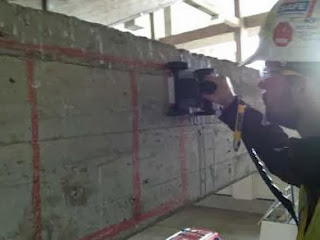
When you need to penetrate a concrete structure for installation of utilities or other reasons, you need to accurately determine the position of the reinforcement bars that are always part of a concrete structure. When undertaking further work, this is where the techniques used in concrete scanning can be of enormous help and enable you to pinpoint locations so there are no other problems.


Concrete scanning can not only help to locate rebar, but also locate conduits and cables. It can estimate the depth of the slab, detect voids and other utilities. This technology is also very much in use to detect underground facilities and utilities in areas that have been carpeted over by asphalt or concrete, or are under open ground. Thus helps to reduce chances of disruption of services. Recently, wrong utility maps led to a major 120 inch water main located 200 feet below ground being damaged by well drilling
equipment. This led to major disruption of the water supply, major problems in its repair, and other inconveniences that could have been avoided by the use of proper concrete scanning equipment.

Concrete scanning uses ground penetrating radar to act and locate like an X-ray of the area being served. This enables 2D and3D maps to be obtained at various levels below the scanned surface, which experts can identify easily and give complete reports on the obstructions that any planned action is likely to encounter. Such concrete scanning or ground penetrating radar has also been used in archaeological projects, so that objects below the earth and in digs are located, their shapes known and likely depths of excavation required, are known. This allows the archaeologist to plan work to reach artifacts if the scans do show them as something unusual. This radar sends high frequency sound waves through the surface being scanned and the reflection of these waves back to instruments on the ground acts to provide information of what lies hidden.